Christmas Outline Vector Illustrations Review
As a graphic designer who has spent the last decade refining brand identities and seasonal campaigns for small businesses, I approach every new graphic design asset with a healthy dose of skepticism. We have all been there: downloading a bundle that looks stunning in the preview thumbnail but falls apart when you try to scale it for a large format print or simplify it for a minimalist logo. Recently, I had the opportunity to integrate Christmas Outline Vector Illustrations into a real-world client project, and I want to share my practical assessment of how these assets perform under professional scrutiny.
The client was a boutique handmade candle company looking to launch a limited-edition holiday collection. Their brand identity is rooted in warmth, simplicity, and artisanal quality. They needed marketing visuals that felt festive without being cluttered or overly commercial. This is where the specific style of Illustrations becomes critical. Upon first inspection, the mood created by these outline vectors is one of understated elegance. Unlike heavy, filled clipart that can dominate a layout, line art offers breathing room. It suggests rather than shouts, which is exactly what a sophisticated small business branding strategy requires during the noisy holiday season.
Visual Mood and Stylistic Versatility
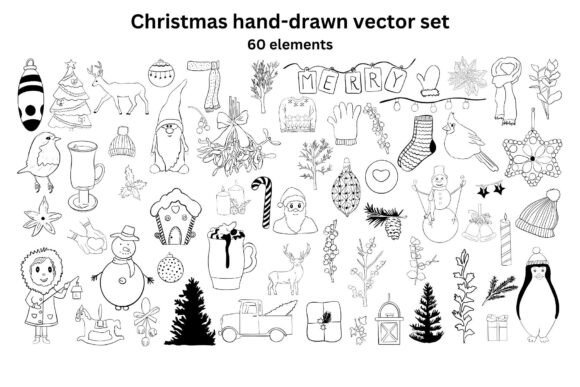
The aesthetic of these Christmas Outline Vector Illustrations leans heavily into modern minimalism. The lines are clean, consistent in weight, and devoid of unnecessary noise. This makes them incredibly versatile for creative design applications. In my initial tests, I found that these vectors pair exceptionally well with both serif and sans-serif typography. When combined with a classic serif font, the outlines evoke a traditional, storybook feel. Switch to a geometric sans-serif or a handwritten script, and the same assets instantly modernize, fitting perfectly into a contemporary digital product launch.
For designers working in the creative marketplace, understanding this flexibility is key. These are not just static images; they are foundational elements for brand identity. I used several of the pine branch and ornament outlines to create a custom border for the client’s packaging labels. Because they are vector-based, scaling them up for a large poster or down for a tiny sticker required zero loss in quality. This scalability is non-negotiable for any serious commercial design workflow.
Performance in Real-World Design Scenarios
Let’s discuss where these assets truly shine. I deployed them across several touchpoints for the candle campaign. First, for packaging design, the outline style allowed us to use single-color printing, which significantly reduced production costs while maintaining a high-end look. The visual hierarchy remained clear because the thin lines did not compete with the product name or scent description.
Second, for social media graphics, specifically Instagram posts and Pinterest pins, the open nature of the line art allowed the background photography to show through. This is crucial for lifestyle brands where the product image is the hero. The Illustrations acted as subtle decorative accents rather than overpowering the visual narrative. I also tested them in a Canva template for the client’s email newsletter. The SVG files imported cleanly, allowing for easy color customization to match their brand palette without needing to open complex editing software.
For those in the print-on-demand or Etsy product space, these vectors are ideal for t-shirt design and sublimation design. The clean paths mean that cutting machines like Cricut or Silhouette will have no trouble reading the nodes. I created a few Cricut project prototypes for holiday gift tags, and the weeding process was straightforward because the lines were not overly intricate. This makes them a strong candidate for printable design sellers who need reliable files that minimize customer support issues regarding cut errors.
Strategic Limitations and Careful Usage
However, no asset is perfect for every situation. Designers must be cautious when using Christmas Outline Vector Illustrations in crowded layouts. Because line art relies on negative space, placing it over a busy photographic background can cause visibility issues. I learned this the hard way when testing a draft for a web banner. The thin lines disappeared against the textured wood background. The fix was simple—adding a solid white container behind the illustration—but it serves as a reminder to always check contrast.
Additionally, these outlines may not be suitable for corporate materials that require a very strict, bold visual presence. If your logo design needs to be legible from a distance, such as on a storefront sign, ultra-thin outlines might vanish. In such cases, I recommend thickening the stroke weight significantly or using the outlines only as secondary elements in editorial design or supporting web design components. They are less effective for sticker design if the final output is very small, as the fine details may blur or break during the printing process.
Practical Designer Notes for Commercial Use
Before you commit these assets to a client project, here is my checklist for ensuring professional results. First, always test the vectors in black and white. If the design loses its integrity without color, it may rely too much on hue rather than form. Second, inspect the file formats. Ensure you have access to the true SVG design files for editing and high-resolution PNG design files with transparent backgrounds for quick drag-and-drop use in tools like Canva.
Check the commercial licensing explicitly. As professionals, we cannot assume a design bundle includes unlimited commercial rights. Verify if the license covers commercial license usage for physical products versus digital resale. Finally, preview the assets on actual mockups. A product mockup reveals how the clipart interacts with real-world textures and lighting, providing a more accurate representation than a flat digital screen.
In conclusion, Christmas Outline Vector Illustrations are a robust addition to any designer’s toolkit, particularly for projects prioritizing elegance and versatility. They excel in handmade business contexts, packaging design, and social media graphics where subtlety is valued. By respecting their limitations regarding contrast and scale, you can leverage these design assets to create polished, professional, and emotionally engaging holiday campaigns.